Golden Pictures studio
Queen of HeartsGolden Pictures studio is both a working film lot and the setting where Cy Goldman’s control over production becomes concrete. Its streets and palace interiors are constructed environments; its actual pressures come from repeated takes, casting decisions, and contracts that bind performers to the studio.
Setting and Layout
When Lady Georgiana Rannoch visits, a gatekeeper salutes as her car passes beneath the GOLDEN PICTURES sign. The lot contains a mock old-fashioned town square and a European village, where young men in lederhosen and girls in dirndls are filming. The car then turns into a narrow alley between buildings, revealing how the grounds are arranged as linked sets rather than an ordinary town.
A large, dark soundstage holds a palace-room set, where Claire Daniels and Juan de Castillo are working on a scene. Elsewhere on the lot, a real-looking castle has been built, with a private dining room used by Goldman during a break. This constructed castle belongs to the studio grounds; the separate destination of a weekend visit is Goldman’s Alhambra Two estate.
Filming and the Sound of Performance
The palace scene pairs Claire, dressed for her role as a queen, with Juan as a king. After the first take, the production team tells Juan to soften his accent and lisp so that the intended audience can understand him. Juan objects that his accent is how he speaks and that the character is a Spanish king; the crew’s concern is not authenticity alone, but intelligibility for viewers in Peoria.
The same passage is repeated thirty-four times. Claire says the repetition helps explain why she prefers theatre, while noting that Juan would need weeks with a speech coach to change his delivery. Goldman is dissatisfied with the result and considers Juan unsuitable for the leading part, despite acknowledging his appearance and appeal. The studio thus makes vocal performance a practical condition of employment: a distinctive accent can express cultural identity on screen and still count against an actor in casting.
Casting, Contracts, and Authority
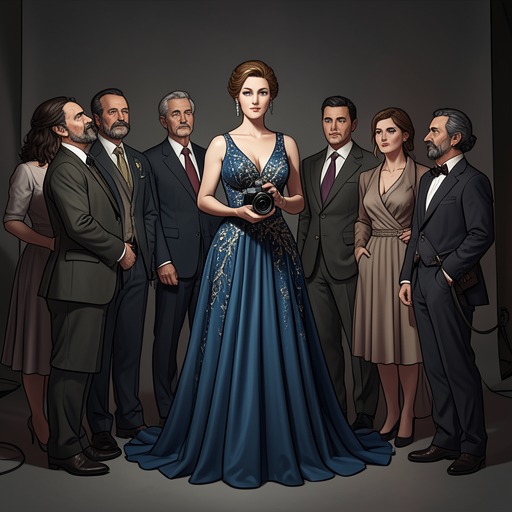
Goldman’s decisions reach beyond the rehearsal room. He brings Craig Hart in as an alternative for the role, and later tells Juan that his accent is the problem. When Juan challenges his removal from the picture, Goldman invokes the contract: Juan belongs to Golden Pictures, as do Stella Brightwell and Craig, and must follow the studio’s direction. He offers Juan a smaller part and voice coaching, while casting Darcy O’Mara as Don Alonso.
The lot’s boundaries are also enforced against visitors. When Ronnie sees Algie Broxley-Foggett at the entrance, he says guests are not allowed on the set under Goldman’s orders. Access, like casting, is controlled from above. The studio is not merely where a film is made; it is an institution that decides who may enter, which performances qualify, and what work a contracted actor may be given.
Career Pressures on the Lot
Those decisions carry particular weight during the transition to sound films. Goldman uses Stella’s voice as a reason to threaten her place in the production, warning that Claire Daniels will outact her. On set, Lady Georgiana observes that Claire seems at home in the scene while Stella’s voice and appearance do not match the young role she is playing. The contrast turns the production itself into a contest over who can satisfy the demands of a film career.
From the studio, the story follows the company’s power beyond the soundstage: Goldman gathers actors and staff for a weekend at Alhambra Two, and the work of the lot gives way to the private setting of his estate. Golden Pictures studio therefore establishes the machinery behind the film before the plot moves into another arena. Its fabricated streets and palace rooms frame a less artificial struggle over voice, professional standing, and the authority attached to a studio contract.